Glucagon‑like peptide‑1 (GLP‑1) medications — including drugs like Wegovy, Ozempic, Mounjaro, and Zepbound — are widely prescribed for diabetes management and, increasingly, for chronic weight management. These medications have transformed care for millions of patients, but insurance coverage can be complex, especially with a major provider like Cigna.
This article breaks down how Cigna handles GLP‑1 coverage, what you can expect, how costs and requirements work, and what alternatives are available if coverage isn’t offered.
Glucagon‑like peptide‑1 (GLP‑1) medications — including drugs like Wegovy, Ozempic, Mounjaro, and Zepbound — are widely prescribed for diabetes management and, increasingly, for chronic weight management.
These medications have transformed care for millions of patients, but insurance coverage can be complex, especially with a major provider like Cigna. This article breaks down how Cigna handles GLP‑1 coverage, what you can expect, how costs and requirements work, and what alternatives are available if coverage isn’t offered.
Understanding GLP‑1 coverage under Cigna is crucial because these drugs are high-cost and often require prior authorization. Patients need to know which medications are included in their plan’s formulary, what clinical documentation is necessary, and whether their treatment goals—diabetes control or weight management—affect approval.
Many individuals assume that having insurance automatically guarantees coverage, but in reality, approval depends on plan type, employer decisions, and medical necessity. This guide provides clear insights, practical tips for navigating insurance, and detailed comparisons to help patients and healthcare providers make informed decisions. By the end, you’ll have a complete picture of how to approach GLP‑1 medications under Cigna, maximize benefits, and reduce out-of-pocket costs.
1. What Are GLP‑1 Medications?
GLP‑1 medications are a class of injectable or oral drugs that mimic the “glucagon‑like peptide‑1” hormone. They help regulate blood glucose levels, improve insulin secretion, delay gastric emptying, and can reduce appetite — which is why they’re used for both type 2 diabetes and chronic weight management. Popular GLP‑1 medications include Wegovy, Ozempic, Mounjaro, and Zepbound.
These drugs not only help with glucose control but also support significant weight loss, which can reduce the risk of heart disease and improve overall metabolic health. GLP‑1s are typically prescribed alongside lifestyle changes, including diet and exercise, to maximize their effectiveness. Their success in clinical trials has made them a key tool in modern diabetes and obesity management.
GLP‑1 medications are a class of injectable or oral drugs that mimic the “glucagon‑like peptide‑1” hormone. They help regulate blood glucose levels, improve insulin secretion, delay gastric emptying, and can reduce appetite — which is why they’re used for both type 2 diabetes and chronic weight management. Popular GLP‑1 medications include:
- Wegovy (semaglutide)
- Ozempic (semaglutide)
- Mounjaro (tirzepatide)
- Zepbound (tirzepatide)
These medicines are often effective but may come with high retail prices without insurance.
2. Does Cigna Cover GLP‑1 Medications?
Yes, but coverage is not guaranteed for everyone. Whether Cigna pays for a GLP‑1 medication depends on several key factors, including the specific plan you are enrolled in, whether the drug is FDA-approved for your medical diagnosis, and whether your employer or plan sponsor has included GLP‑1 coverage in your benefits.
Coverage also often requires prior authorization, meaning your healthcare provider must submit clinical documentation proving the medication is medically necessary.
Many Cigna plans provide coverage for GLP‑1 medications prescribed for type 2 diabetes, while coverage for weight management purposes is more limited and varies widely. Patients should be aware that even if a medication is covered, it may fall into a specialty tier, leading to higher copays or coinsurance.
Understanding your plan’s formulary and requirements in advance can help avoid unexpected out-of-pocket costs. With proper preparation and documentation, patients can increase the likelihood of approval and make these effective treatments more accessible.
Quick Answers:
Yes, but coverage is not guaranteed for everyone.
Whether Cigna pays for a GLP‑1 medication depends on several key factors:
✔ Your specific Cigna plan (commercial, employer‑sponsored, individual/private plan, Medicare Advantage)
✔ Whether the drug is FDA‑approved for your medical diagnosis (e.g., diabetes vs. weight loss)
✔ Whether your employer or plan sponsor opted to include GLP‑1 coverage
✔ Prior authorization and clinical documentation requirements
In short:
- Some Cigna commercial plans cover GLP‑1s with prior authorization.
- Many plans exclude GLP‑1s for weight management altogether.
- Coverage is more likely if the medication is prescribed for diabetes rather than weight loss.
3. How Cigna Coverage Varies by Plan Type
| Plan Type | Coverage Likelihood | Notes |
| Employer‑Sponsored Commercial Plans | Moderate–Varies | Coverage depends on whether the employer adds GLP‑1 drugs to the benefits; most require prior authorization. |
| Individual & Marketplace Plans | Low–Varies | Many individual ACA plans exclude anti‑obesity GLP‑1 drugs. |
| Medicare Advantage Plans | Low | Medicare Part D generally does not cover weight loss drugs; diabetes use may still apply. |
| Self‑Funded Employer Plans | Varies Widely | Plan sponsor decides coverage; some include GLP‑1s, others do not. |
Key takeaway: Employer choices and plan design largely determine whether GLP‑1s are covered — not simply the fact that you have Cigna insurance.
4. What GLP‑1 Coverage Looks Like Under Cigna?
When Cigna covers GLP‑1 medications, most plans require prior authorization, meaning your doctor must provide clinical documentation proving medical necessity. Coverage often places these drugs in specialty tiers, which can lead to higher copays or coinsurance.
“This infographic illustrates what GLP‑1 coverage looks like under Cigna, including plan variations, prior authorization, formulary tiers, and coverage scenarios.”
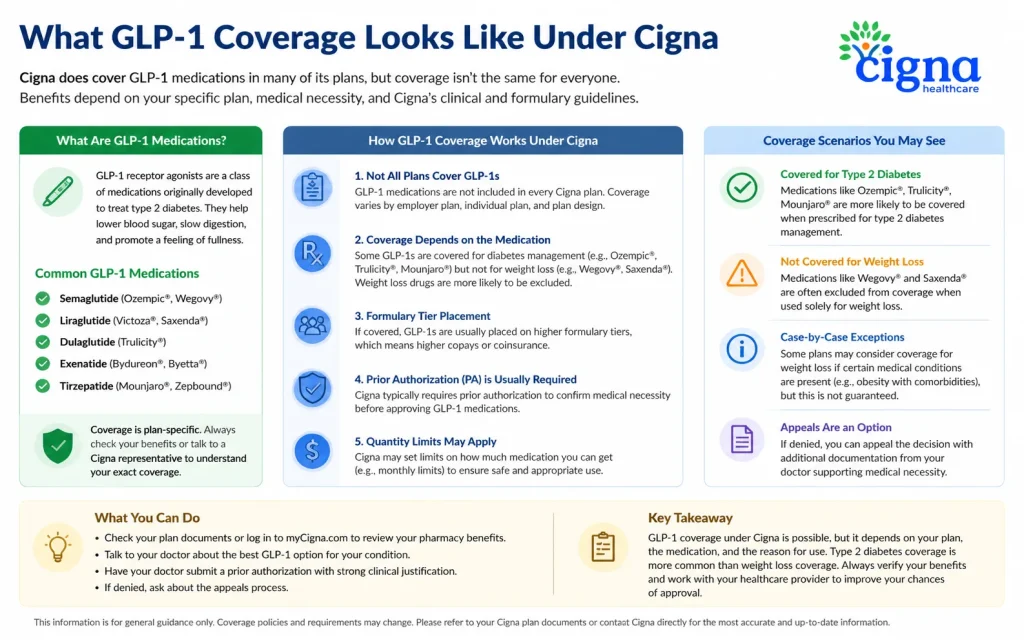
Some medications are preferred or non-preferred on the formulary, affecting costs and pharmacy options. Coverage is more common for type 2 diabetes than for weight management. Understanding these rules helps patients plan for approvals and potential out-of-pocket expenses.
When GLP‑1 medications are covered, coverage terms can vary:
1. Prior Authorization Is Common
Most Cigna plans that include GLP‑1 medications require prior authorization. This means:
- The doctor must submit the medical records and justification
- BMI, medical history, and diagnosis may need documentation
- You may need proof of prior lifestyle interventions
Prior authorization ensures the drug is medically necessary under your plan’s rules.
2. Tier Placement and Cost‑Sharing
If a GLP‑1 drug is covered, it may fall into a:
- Specialty drug tier
- Higher copay tier
- Coinsurance percentage requirement
Out‑of‑pocket costs can still be high even if covered.
3. Coverage for Weight Loss vs. Diabetes
Insurance often favors coverage for diabetes treatment, for which all GLP‑1s are FDA‑approved for. Coverage for weight management varies widely and may be excluded from drug lists on some plans.
5. How Cigna’s Pharmacy Benefit Manager Affects Coverage
Cigna often uses Express Scripts as its pharmacy benefit manager (PBM), which plays a central role in determining GLP‑1 coverage. The PBM maintains the drug formulary, deciding which medications are included and how they are categorized.
It also sets tier placement, which influences copays and coinsurance, and handles prior authorization requests to confirm medical necessity. Express Scripts negotiates pricing with pharmacies and manufacturers, which can significantly impact out-of-pocket costs for patients. Depending on the plan, GLP‑1 drugs may be covered, require prior approval, or be excluded entirely.
Some medications are designated as preferred, making them more affordable, while non-preferred options carry higher costs. Understanding the PBM’s policies helps patients plan treatment, avoid coverage surprises, and utilize available cost-saving programs. Working closely with your healthcare provider to meet PBM requirements can improve the chances of approval and ensure smoother access to these medications.
Most Cigna plans use Express Scripts as their pharmacy benefit manager (PBM). The PBM:
✔ Maintains the drug formulary (list of covered drugs)
✔ Handles prior authorization processing
✔ Negotiates pricing with pharmacies and manufacturers
Express Scripts sets tier placement and coverage rules — meaning drugs like Wegovy or Zepbound might be:
- Covered with prior authorization
- Not covered or excluded
- Covered with a monthly cost cap (in some plans)
For example, Cigna has introduced programs capping out‑of‑pocket costs at around $200/month on certain plans to improve affordability.
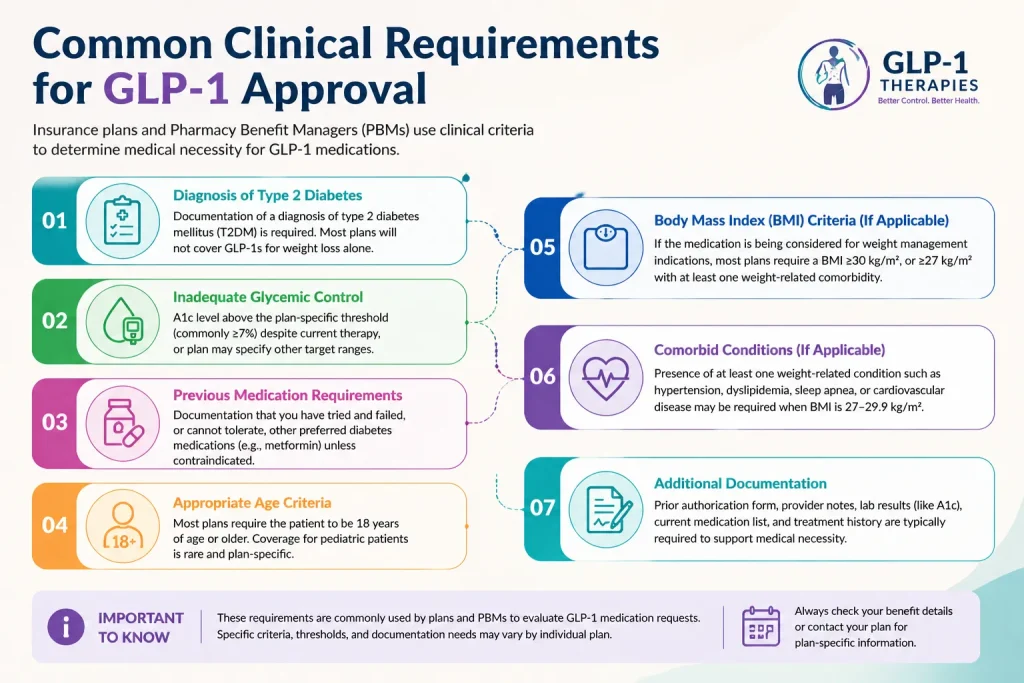
6. Common Clinical Requirements for GLP‑1 Approval
Cigna typically requires proof of medical necessity before approving GLP‑1 medications. Patients often need to meet specific BMI thresholds and show evidence of comorbid conditions such as type 2 diabetes, hypertension, or cardiovascular risk factors.
Most plans also expect documentation of previous lifestyle interventions, including diet and exercise attempts. Prescribers must submit a detailed treatment plan explaining the intended use and duration of the medication. Clinical records, lab results, and weight history are frequently requested to support approval.
Some plans may require step therapy, meaning patients must try alternative medications before GLP‑1s are authorized. Meeting these criteria improves the likelihood of coverage and helps avoid denials. Understanding these requirements early can streamline the approval process and reduce delays in starting treatment.
Insurance typically wants proof that the prescribed treatment is appropriate. Most Cigna plans that cover GLP‑1s require documentation such as:
- Body Mass Index (BMI) thresholds
- Presence of comorbid conditions (e.g., hypertension, diabetes)
- Evidence of lifestyle and behavioral interventions attempted
- A treatment plan from a prescribing medical professional
If these criteria aren’t met, your GLP‑1 prior authorization may be denied.
“You can refer to the infographic below for a visual summary of the common clinical requirements for GLP‑1 approval, which highlights key steps, documentation, and criteria for easier understanding.”
7. What to Do If Your Cigna Plan Doesn’t Cover GLP‑1s
If your Cigna plan doesn’t cover GLP‑1 medications, there are several steps you can take. First, consider filing an appeal with supporting medical documentation to request coverage. Next, speak with your employer or plan administrator to see if coverage can be added or reviewed. You can also explore manufacturer savings programs or discount cards to lower out-of-pocket costs.
Additionally, during open enrollment, compare other Cigna plans or marketplace options that may include GLP‑1 coverage. Working closely with your healthcare provider can improve approval chances and help you access these treatments affordably.
If you find your plan doesn’t cover the GLP‑1 medication you need, here are options to explore:
1. Appeal the Denial
Ask for:
- The reason for the denial in writing
- Instructions on how to submit an appeal
- A peer‑to‑peer review between your doctor and the Cigna review team
Appeals must usually be filed within a specific timeframe.
2. Talk to Your Employer or Plan Administrator
If your plan is employer‑sponsored:
✔ HR can review whether GLP‑1 coverage can be added
✔ Some employers review benefit design at annual renewals
Employers have a major say in whether weight management drugs are covered.
8. GLP‑1 Drugs and Their Typical Insurance Coverage
Here’s a simplified view of how major GLP‑1 drugs fare under Cigna coverage:
| Prescriptions may be covered for diabetes; weight loss coverage is often limited. | Common Coverage Scenario with Cigna |
| Wegovy | Covered with prior authorization in some employer plans; often excluded in individual/Medicare plans. |
| Ozempic | Coverage more common for diabetes treatment; weight loss coverage varies. |
| Mounjaro | Prescription may be covered for diabetes; weight loss coverage often limited. |
| Zepbound | Similar to Wegovy — covered in some plans with authorization; may be excluded in others. |
Tips to Maximize Your Insurance Success
✔ Confirm your plan’s drug formulary online or with Cigna member services.
✔ Work with your prescriber on prior authorization submissions (updated clinical data improves approval odds).
✔ Keep records of prior treatments, vitals, and BMI.
✔ Contact your plan’s customer service for specific coverage details.
Frequently Asked Questions ( FAQs )
1. Does Cigna cover GLP‑1 medications for weight loss?
Coverage for GLP‑1 medications for weight management varies widely depending on your plan and employer. Many commercial and individual plans do not include weight loss as a covered indication. However, some employer-sponsored plans may provide coverage with prior authorization and clinical documentation. Always check your plan’s formulary and confirm with member services before starting treatment. If coverage is not available, appeals or manufacturer programs may help reduce costs.
2. Does Cigna cover GLP‑1 drugs for type 2 diabetes?
Yes, GLP‑1 medications are more commonly covered when prescribed for type 2 diabetes, as these drugs are FDA-approved for glucose control. Coverage typically requires prior authorization to confirm medical necessity. Depending on your plan, they may be placed in specialty tiers, affecting copay or coinsurance. Working with your provider to submit all required documentation improves the likelihood of approval.
3. What is a prior authorization, and why is it required?
A prior authorization is a process in which Cigna or its PBM reviews clinical documentation before approving coverage for a medication. It ensures the drug is medically necessary for your condition. Without prior authorization, your claim may be denied at the pharmacy. Submitting complete records, including BMI, lab results, and treatment history, helps streamline the approval process.
4. Can I appeal if Cigna denies GLP‑1 coverage?
Yes, you can file an appeal if your coverage is denied. Typically, you must submit additional clinical documentation, including a treatment plan and prior health records. You may also request a peer-to-peer review, where your doctor speaks directly with a Cigna reviewer. Appeals usually have a defined timeframe, so it’s important to act promptly.
5. Are GLP‑1 medications expensive even with coverage?
GLP‑1 drugs often fall into specialty tiers, meaning your copay or coinsurance can be significant. Some plans have monthly cost caps or discounts through manufacturer programs. Prior authorization and formulary status also influence costs. Confirming coverage and exploring savings programs can reduce out-of-pocket expenses significantly.
6. How can I check if my Cigna plan covers a specific GLP‑1 medication?
You can verify coverage by logging into your Cigna member portal or calling member services. Check the formulary to see if your prescribed drug is preferred or non-preferred. Your doctor’s office can also submit prior authorization forms and guide approval requirements. Reviewing coverage before starting treatment helps avoid surprises.
7. Do I need to try other medications before getting a GLP‑1 approved?
Some Cigna plans require step therapy, meaning patients must attempt alternative medications first. This is more common for weight management prescriptions. Your provider will need to document prior treatments and why they were insufficient. Step therapy ensures coverage aligns with clinical guidelines and insurance requirements.
8. Are there manufacturer programs to help if Cigna doesn’t cover GLP‑1s?
Yes, most GLP‑1 manufacturers offer savings programs or discount cards to reduce patient costs. These programs can sometimes make medications affordable even if insurance coverage is limited or excluded. Eligibility and savings vary by manufacturer, so check their websites or ask your provider for enrollment guidance.
9. Conclusion
Navigating GLP‑1 coverage under Cigna can be complex, as approval depends on plan type, FDA-approved indications, and prior authorization requirements.
Coverage is generally more consistent for type 2 diabetes than for weight management, and out-of-pocket costs may vary depending on tier placement. Understanding your plan’s formulary, meeting clinical documentation requirements, and exploring manufacturer savings programs can help reduce costs and increase access.
If your plan doesn’t cover GLP‑1 medications, appeals and alternative plan options may offer solutions. Working closely with your healthcare provider ensures that all necessary documentation is submitted correctly, improving the likelihood of approval. By staying informed and proactive, patients can access these highly effective medications and optimize their treatment outcomes.